
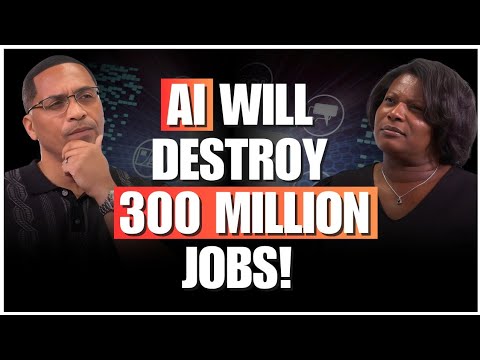
As artificial intelligence and automation technologies advance at an unprecedented pace, up to 300 million jobs globally could be significantly disrupted or eliminated according to Goldman Sachs. This seismic shift in the workforce requires professionals at all levels to adapt their skills, mindset, and approach to remain valuable in an increasingly automated world.
Understanding how to effectively work alongside AI tools while developing irreplaceable human capabilities will be crucial for career survival and growth in the coming years.
In my recent video discussion with Jahleel Stewart, a global HR expert with 30+ years of experience, we explored the profound impacts of automation on the workforce and what professionals need to do to stay ahead:
The Scale and Speed of Workforce Automation
According to recent forecasts, two-thirds of jobs in the United States and Europe could be partially automated. The jobs most vulnerable to disruption include:
- Office and administrative support
- Legal services
- Finance teams
- Data entry
- Bookkeeping
- Paralegal work
What makes this transition different from previous technological disruptions is the unprecedented speed of change. While past innovations like the industrial revolution took decades to transform industries, AI is already rapidly changing how work gets done across sectors.
The Evolution of Expert Knowledge
One of the most significant shifts has been in how we access and utilize expertise. As Jahleel noted, “Over time, we’ve seen the expert become the internet.” Where professionals once relied heavily on years of accumulated knowledge, AI tools can now instantly access and synthesize vast amounts of information.
Beyond Technical Skills: The Human Element
While certain technical and routine jobs face automation, roles requiring these human qualities remain more resistant:
- Emotional intelligence
- Creativity
- Complex problem-solving
- Systemic thinking
- Contextual understanding
The Rise of New Roles and Skills
As some jobs disappear, new opportunities are emerging. For example, prompt engineering has become a crucial skill – the ability to effectively direct AI tools to achieve desired outcomes. Success in the automated workforce isn’t just about technical capability, but understanding how to leverage technology creatively.
Adapting to Change: Essential Strategies
To remain valuable in an increasingly automated workplace, professionals should focus on:
- Developing intellectual curiosity
- Building systemic thinking capabilities
- Understanding technology’s broader impacts
- Maintaining adaptability and resilience
- Pursuing continuous learning and skill development
The key isn’t to compete against automation but to develop complementary skills that enhance your ability to work alongside AI tools effectively. This requires both technical competency and advanced cognitive capabilities that machines cannot easily replicate.